Our Lake Manitou Loons
written by Judi Adams
Does the call of a loon enthrall you? Are you captivated by the sight of loons on Lac Manitou? Let’s get to know some fascinating facts about our loons.
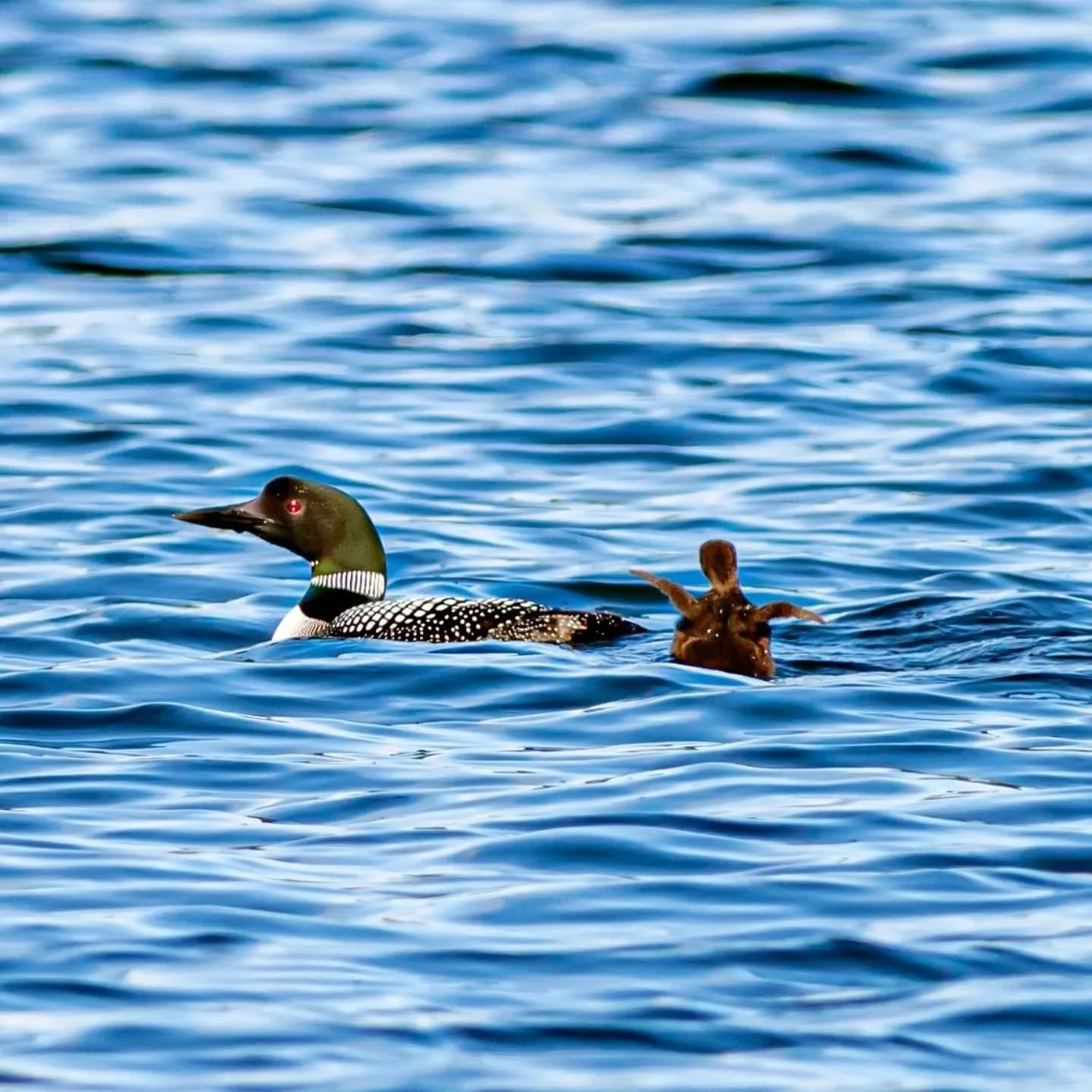
Lake Manitou loon and baby. Photograph by Gabi Opas.
Where do loons go in the winter?
Our Lac Manitou Common Loons (Gavia immer) spend November to March in salt water close to the Atlantic coastline in bays and coves, from Newfoundland southward to the Gulf of Mexico. Some migrating loons can fly at speeds more than 100 kph.
When do they come back to Lake Manitou?
Spring migration goes from March until June, (most in April). Manitou loons have been seen in April, swimming between the ice floes. The males come first to defend their territory and the females arrive a week or more later. The females typically rejoin their male partner from the previous year. Monogamous pair bonds may last for several years.
Do the same loons return to our lake every year?
Loons tend to return to the same lake and nesting site year after year, especially if the nest was successful. The common loon can live between 15-30 years so some of our Manitou loons may have been on Lac Manitou for many years.
Do loons nest and lay eggs in our region?
The male chooses the nest site. During May and June, both male and female build and maintain their nest. Their simple nests consist of heaped vegetation or merely a shallow scoop, but must be beside water as loons cannot walk easily on land. Loons tend to be secretive around their nests. If you see a nest, please stay away and protect their secret.
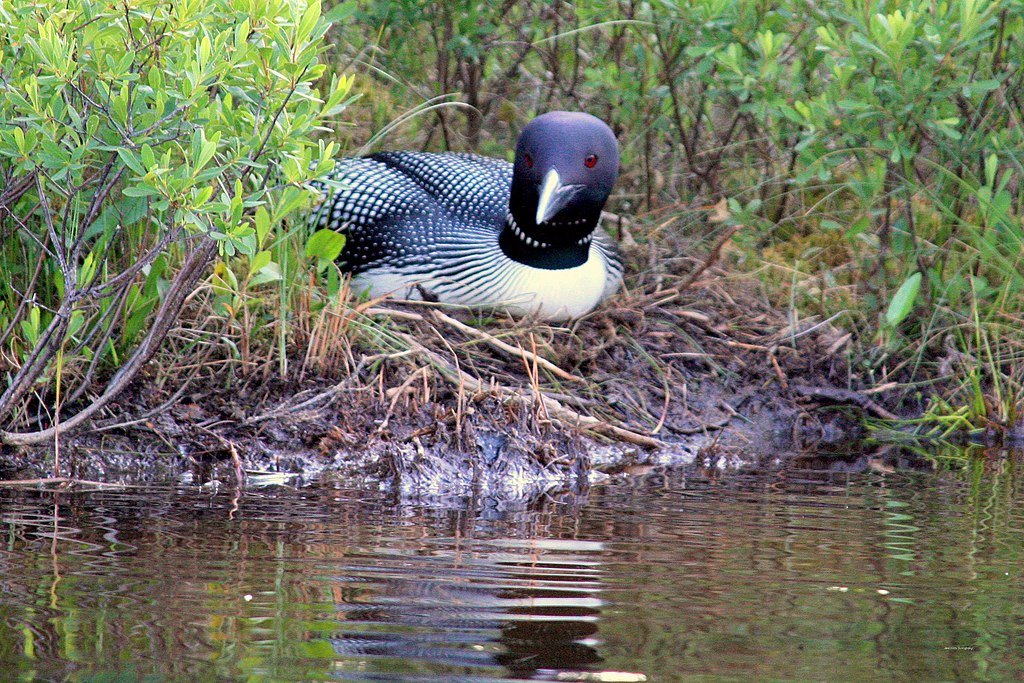
Loon on nest.
Waves and high water can be deadly for loon nests – a rise in water level over 15 cm (6 in) will flood the nest and/or potentially wash the 1-2 eggs into the water. Boat traffic creates wakes that may wash out nests or separate young loons from their parents, which are then vulnerable to predators such as gulls, ravens and otters. So please respect the speed limits on Lac Manitou and keep your wake to a minimum.
Parents take turn incubating the eggs for 27-30 days. If you see a solitary loon, it may be that the mate is on the nest protecting the egg(s). Both mates aggressively defend against other loons, waterfowl, and other wildlife that compete for their main prey: fish.
What happens when the loon eggs hatch?
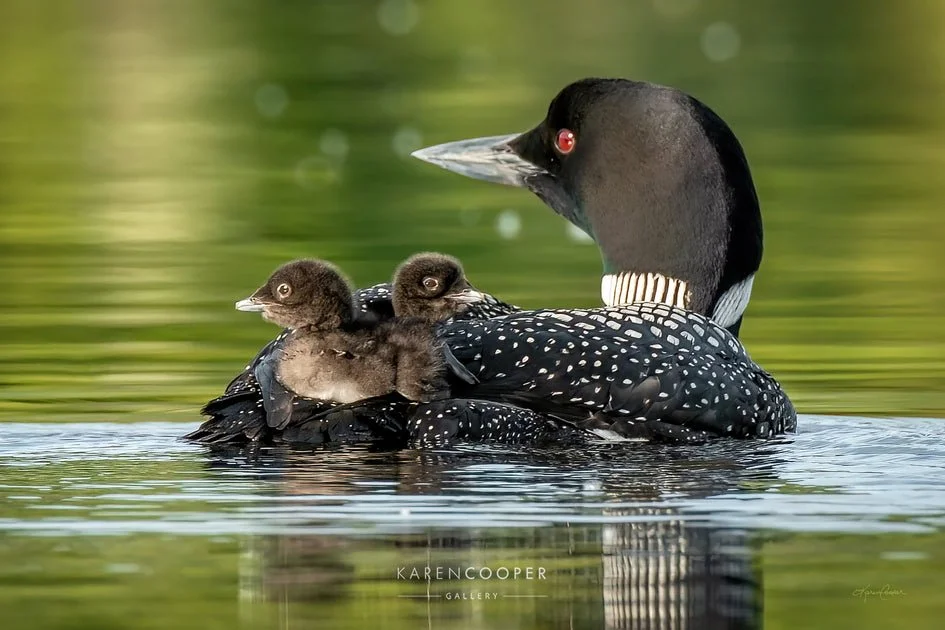
Two loonlets riding on parent’s back. Photo by Karen Cooper.
After hatching, the fluffy, brown loonlets quickly take to the water. They stay warm by riding on their parents’ backs, a practice that shields them from predators both underwater and above. When you meet loons with chicks, it is important to respect their space. If the loons show signs of stress such a moving away or vocalizing with tremolos, it indicates that they need more distance from you. Please respect them by keeping your distance.
By 3-4 weeks the young are too large to ride on their parents’ backs. By 8-9 weeks they have developed their scalloped white and gray/brown, gray appearance. At 12 weeks the juvenile fledglings are now able to fly and capture almost all of their food. They will often gather in large groups. They usually leave their natal lake after their parents, migrating to the coast for the winter, where they will spend the next two to four years before returning to the breeding grounds.
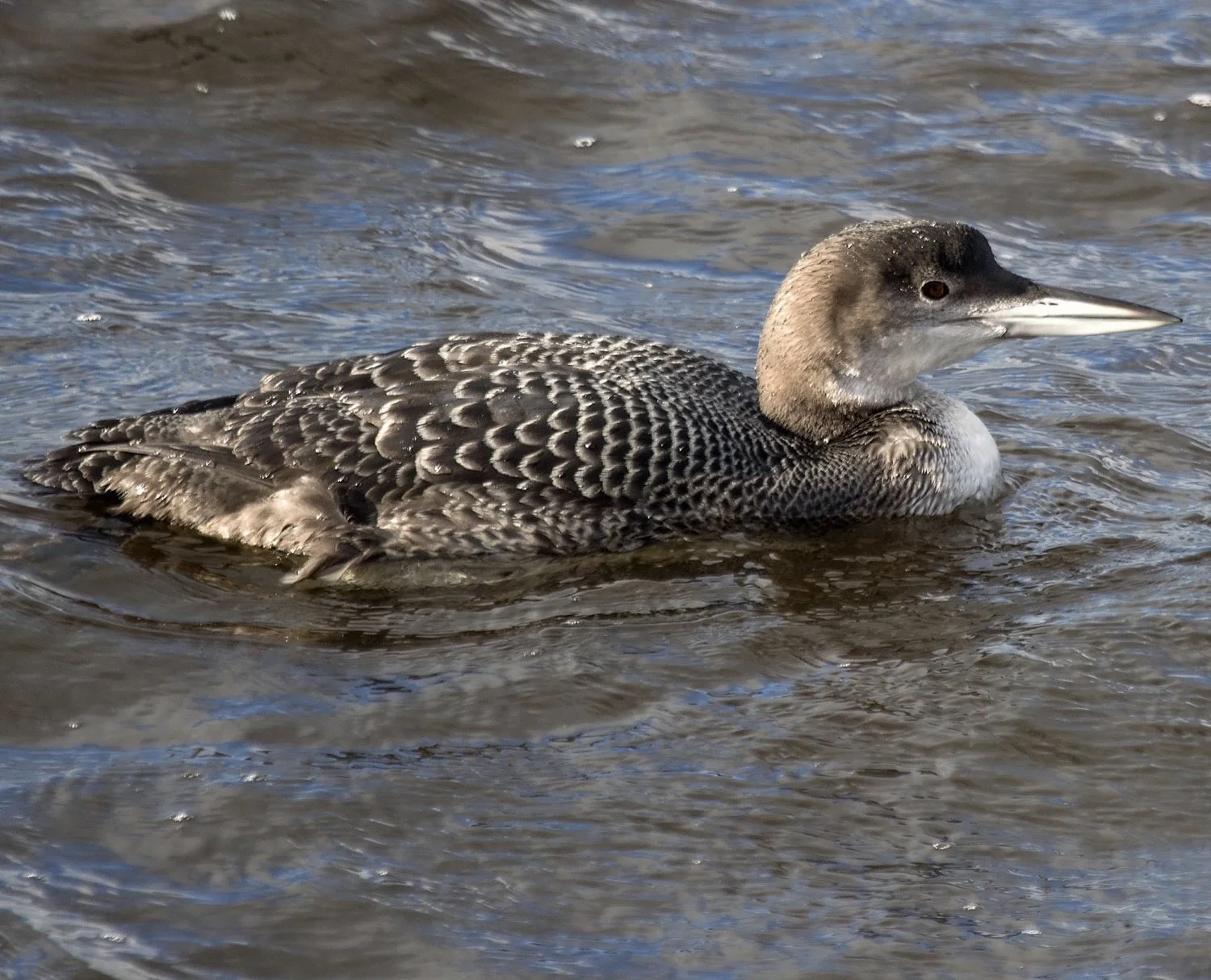
Juvenile loon. Photo credit ReighHiggins
What about loon-human interaction?
Loons can recognize individual humans and can differentiate between positive and negative interactions.
How long have loons been around?
Common loons belong to one of the oldest bird line lineages, with fossils dating back 35 million years.
Why do they have red eyes?
Their distinctive red eyes help them see fish better in deep water by filtering out blue and green light.
What do loons eat?
Loons eat a diet primarily of fish. Examples include perch, sunfish, suckers, catfish, smelt, and minnows. They supplement the fish diet with crustaceans like crayfish, as well as snails and leeches, aquatic insect larvae, and amphibian such as frogs and salamanders. To aid digestion, loons will swallow small pebbles to help crush indigestible materials.
Loons are killed by lead fishing tackle because they mistake it for the pebbles they swallow. This causes fatal lead poisoning. Please switch to non-toxic fishing tackle and properly dispose of old lead tackle.
How can I help the loon population on our lake?
Loon populations are shrinking in Canada. If you want them to survive on our beautiful lake and for their babies to grow into adults, please stay away from nests, respect your distance when on the lake and watch your wakes near them and near the shoreline. Avoid lead tackle when fishing.
What is the Canadian Lakes Loon Survey?
For 40 years, Birds Canada has sponsored the annual Canadian Lakes Loon Survey. The decreasing number of loons in Canada is cause for concern as loon survival can be a measure of the health of a lake.
The AALM Environment Committee is surveying the loons on various sections of our lake. We look for pairs of loons in June, a pair with a baby in July and a fledgling/juvenile in August. For the past 2 years we have seen a pair of baby loonlets but did not see them survive to the juvenile stage. We need everyone’s help in maximizing their chance of survival.
In the spring AALM will be sending out a reminder of what you can do and look for to protect our loons. We also welcome people (while they are up at Manitou) to share loon sightings to the main volunteer surveyor on their section of the lake.
What are loons saying when I hear their distinctive calls?
Loon.org has lots of great information on these wonderful birds, including a page on their calls. Check it out here: https://loon.org/the-call-of-the-loon/